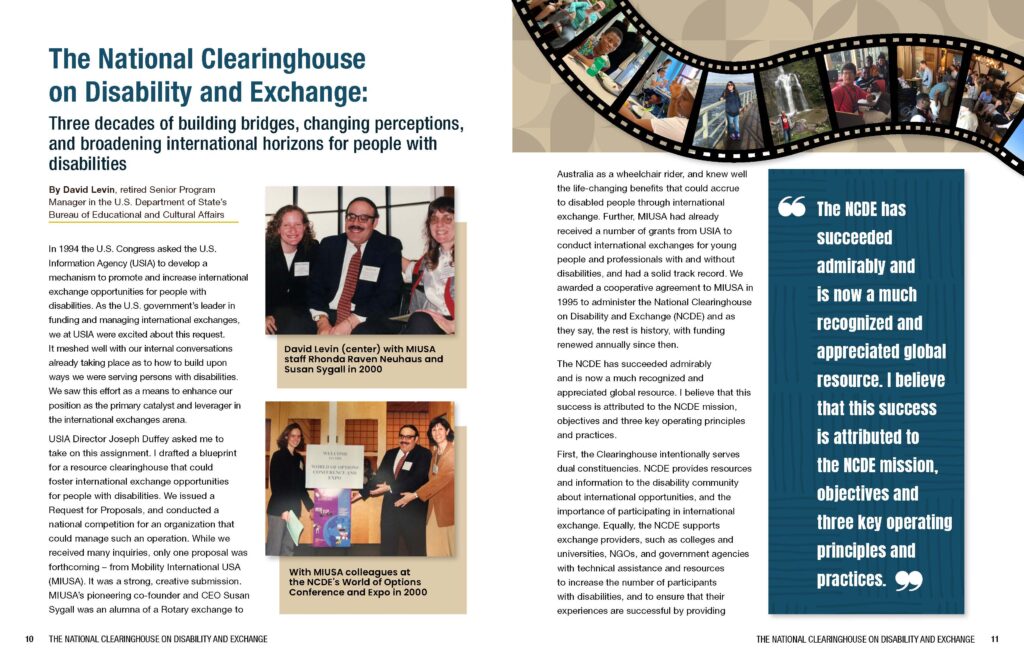
By David Levin, retired Senior Program Manager in the U.S. Department of State’s Bureau of Educational and Cultural Affairs
In 1994 the U.S. Congress asked the U.S. Information Agency (USIA) to develop a mechanism to promote and increase international exchange opportunities for people with disabilities. As the U.S. government’s leader in funding and managing international exchanges, we at USIA were excited about this request. It meshed well with our internal conversations already taking place as to how to build upon ways we were serving persons with disabilities. We saw this effort as a means to enhance our position as the primary catalyst and leverager in the international exchanges arena.
USIA Director Joseph Duffey asked me to take on this assignment. I drafted a blueprint for a resource clearinghouse that could foster international exchange opportunities for people with disabilities. We issued a Request for Proposals, and conducted a national competition for an organization that could manage such an operation. While we received many inquiries, only one proposal was forthcoming – from Mobility International USA (MIUSA). It was a strong, creative submission. MIUSA’s pioneering co-founder and CEO Susan Sygall was an alumna of a Rotary exchange to Australia as a wheelchair rider, and knew well the life-changing benefits that could accrue to disabled people through international exchange. Further, MIUSA had already received a number of grants from USIA to conduct international exchanges for young people and professionals with and without disabilities, and had a solid track record. We awarded a cooperative agreement to MIUSA in 1995 to administer the National Clearinghouse on Disability and Exchange (NCDE) and as they say, the rest is history, with funding renewed annually since then.
The NCDE has succeeded admirably and is now a much recognized and appreciated global resource. I believe that this success is attributed to the NCDE mission, objectives and three key operating principles and practices.
First, the Clearinghouse intentionally serves dual constituencies. NCDE provides resources and information to the disability community about international opportunities, and the importance of participating in international exchange. Equally, the NCDE supports exchange providers, such as colleges and universities, NGOs, and government agencies with technical assistance and resources to increase the number of participants with disabilities, and to ensure that their experiences are successful by providing “reasonable accommodations” as necessary. This dual focus also underlies NCDEs convening of a Roundtable Advisory Committee (RTC) comprised equally of leaders from key international exchange and disability-focused organizations. The RTC advises the Clearinghouse on how the NCDE’s efforts can best jointly serve the two communities, building connections and collaboration between them.
Second, the NCDE’s strength is in its commitment and ability to continually expand and enhance its operations, services, and capabilities. By building on successful activities and responding to feedback from people in the disability and international exchange communities alike, NCDE’s expertise, resources, and services have strengthened over time. Examples of these efforts are extensive website and self-service information database; an annual “A World Awaits You” (AWAY) Journal, highlighting the successful participation of people with disabilities in international exchange; an informative “Access to Exchange” newsletter; a “Ripple Effects” podcast series; Campus Collaboration Campaigns linking education abroad and disability service offices on respective college and university campuses; and successful extern programs which build on exchange alumni experiences.
Strong technology skills have been a hallmark of Clearinghouse operations throughout its history. NCDE staff have become experts at creating fully accessible media, trainings, and virtual and in-person events. These have involved groundbreaking “Joining Hands” conferences, bringing the disability and international exchange communities together for training and dialogue. NCDE activities have taken place in Eugene, Oregon, where MIUSA and the Clearinghouse are based, and in many other places: New York City, Boston, Washington, DC, Chicago, Louisville, Atlanta, Albuquerque, Denver, New Orleans, Houston, Berkeley, Vancouver, Seoul, and Barcelona, to name just a handful.
Third, the NCDE continually enhances its relevance and expertise, by spotlighting specific themes such as international opportunities for participants with visual impairments, people with non-apparent disabilities, youth with disabilities, and disabled community college students. Other themes were highlighted include increasing access to foreign language teaching and learning, experientially-based exchanges, and programs to and from the Muslim world.
The Clearinghouse has been an invaluable partner to the U.S. Department of State, helping it build disability access as an expectation throughout its own constellation of international exchange programs.
These programs extended to Fulbright Programs, International Visitor Leadership programming, youth exchanges, foreign student advising, professional, sports, and cultural exchanges, and study abroad. State Department and partner organization staff in the United States and abroad have developed commitment and experience in this area, often through NCDE training. I have often remarked that I wished there were NCDE-type entities serving other constituencies underrepresented in international exchange.
I was privileged to launch the NCDE, and to work closely with MIUSA through the NCDE’s journey until my retirement in 2023. I appreciated participating in NCDE activities throughout the United States, especially my visits to Eugene for Clearinghouse site-visits. Above all, I truly enjoyed working, for decades, with MIUSA CEO Susan Sygall, with Cindy Lewis, MIUSA’s dedicated Program Director, and of course with the NCDE’s talented and committed project managers over time — Carole Zoom, Pamela Houston, Michele Scheib, Cerise Roth-Vinson, Monica Malhotra, and Laurie Laird. They have all demonstrated the NCDE’s unwavering commitment to its mission and to a firm belief in the value and importance of what it does.
Of all the activities in which I was engaged during my four plus decades of federal service, the NCDE was unique in the way that it enabled us to be creative. For thirty years we collaborated, continually “pushing the envelope,” enhancing and expanding Clearinghouse products, services, operations, reach, effectiveness, and impact.
I congratulate the National Clearinghouse on Disability and Exchange for the status it has achieved, evolving into a respected and valued global resource, and wish it many more years of success. ■
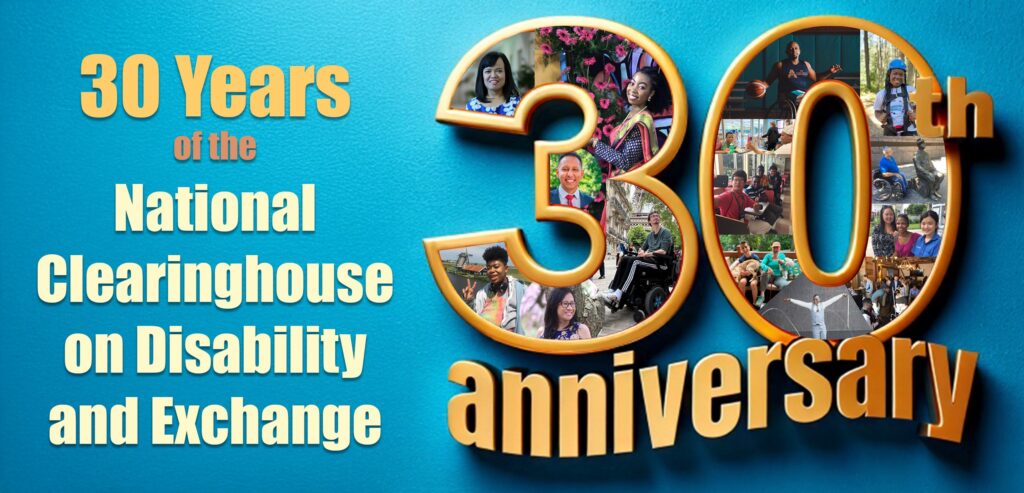
This article is part of the AWAY Journal – NCDE’s 30th Anniversary Issue