By Justin Harford
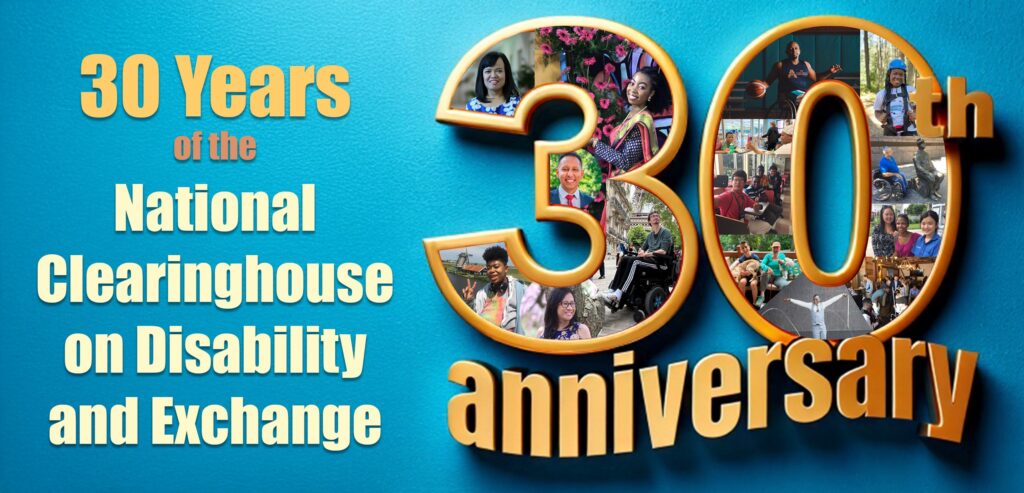
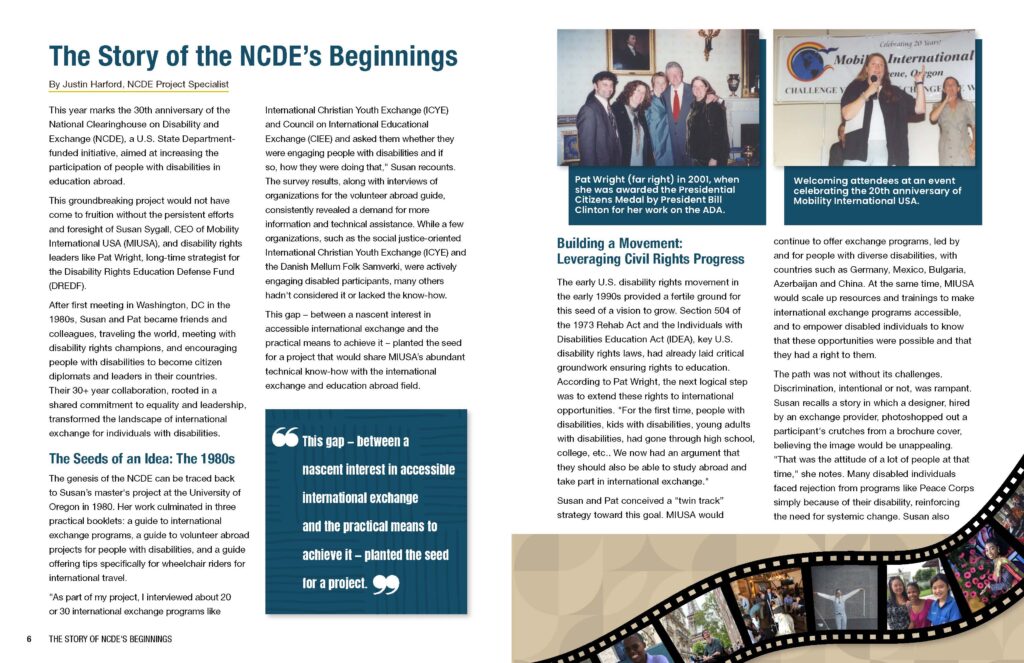
This year marks the 30th anniversary of the National Clearinghouse on Disability and Exchange (NCDE), a U.S. State Department-funded initiative, aimed at increasing the participation of people with disabilities in education abroad.
This groundbreaking project would not have come to fruition without the persistent efforts and foresight of Susan Sygall, CEO of Mobility International USA (MIUSA), and disability rights leaders like Pat Wright, long-time strategist for the Disability Rights Education Defense Fund (DREDF).
After first meeting in Washington, DC in the 1980s, Susan and Pat became friends and colleagues, traveling the world, meeting with disability rights champions, and encouraging people with disabilities to become citizen diplomats and leaders in their countries. Their 30+ year collaboration, rooted in a shared commitment to equality and leadership, transformed the landscape of international exchange for individuals with disabilities.
The Seeds of an Idea: The 1980s
The genesis of the NCDE can be traced back to Susan’s master’s project at the University of Oregon in 1980. Her work culminated in three practical booklets: a guide to international exchange programs, a guide to volunteer abroad projects for people with disabilities, and a guide offering tips specifically for wheelchair riders for international travel.
“As part of my project, I interviewed about 20 or 30 international exchange programs like International Christian Youth Exchange (ICYE) and Council on International Educational Exchange (CIEE) and asked them whether they were engaging people with disabilities and if so, how they were doing that,” Susan recounts. The survey results, along with interviews of organizations for the volunteer abroad guide, consistently revealed a demand for more information and technical assistance. While a few organizations, such as the social justice-oriented International Christian Youth Exchange (ICYE) and the Danish Mellum Folk Samverki, were actively engaging disabled participants, many others hadn’t considered it or lacked the know-how.
This gap – between a nascent interest in accessible international exchange and the practical means to achieve it – planted the seed for a project that would share MIUSA’s abundant technical know-how with the international exchange and education abroad field.
Building a Movement: Leveraging Civil Rights Progress
The early U.S. disability rights movement in the early 1990s provided a fertile ground for this seed of a vision to grow. Section 504 of the 1973 Rehab Act and the Individuals with Disabilities Education Act (IDEA), key U.S. disability rights laws, had already laid critical groundwork ensuring rights to education. According to Pat Wright, the next logical step was to extend these rights to international opportunities. “For the first time, people with disabilities, kids with disabilities, young adults with disabilities, had gone through high school, college, etc.. We now had an argument that they should also be able to study abroad and take part in international exchange.”
Susan and Pat conceived a “twin track” strategy toward this goal. MIUSA would continue to offer exchange programs, led by and for people with diverse disabilities, with countries such as Germany, Mexico, Bulgaria, Azerbaijan and China. At the same time, MIUSA would scale up resources and trainings to make international exchange programs accessible, and to empower disabled individuals to know that these opportunities were possible and that they had a right to them.
The path was not without its challenges. Discrimination, intentional or not, was rampant. Susan recalls a story in which a designer, hired by an exchange provider, photoshopped out a participant’s crutches from a brochure cover, believing the image would be unappealing. “That was the attitude of a lot of people at that time,” she notes. Many disabled individuals faced rejection from programs like Peace Corps simply because of their disability, reinforcing the need for systemic change. Susan also remembers an individual, “very high up” in the U.S. government, who argued that international exchange programs were intended for “citizen diplomats and leaders”, implying that disabled people were neither of these things.
The Fight for Funding: A Congressional Breakthrough
Recognizing the need for official backing, Susan and Pat joined forces with government officials and disability leaders. They engaged with State Department leadership, notably Bob Persico and David Levin, emphasizing that disabled Americans should have the same opportunities as non-disabled peers to important programs such as Fulbright Scholarships and Peace Corps. The idea resonated within the State Department, mirroring a national sense of pride and excitement following the 1993 passage of the ADA.
With State Department support, Susan and Pat took their cause to Capitol Hill. Working with congressional figures like Senator Hatfield (then Chair of the Appropriations Committee), Senator Merkley, and Senator Wyden, they successfully achieved a direct congressional appropriation of funds to the State Department for the purpose of establishing a clearinghouse. Pat explains, “Our strategy was to first educate members of the Appropriations Committee on the absence of people with disabilities in U.S. sponsored exchange programs. We had to identify the specific need, and show that MIUSA was an expert in this area.” MIUSA was the logical recipient of the appropriation, because it was the only entity at the time that could demonstrate an extensive background in planning and executing exchange programs that engaged disabled participants.
The appropriation, secured under Senator Hatfield’s leadership, marked a turning point, signaling a sustained commitment from the State Department that has lasted for 30 years.
The NCDE Today: A Legacy of Change
Susan identifies four significant changes since the NCDE’s inception:
- Shift from “Why” to “How”: The conversation has moved from justifying participation of people with disabilities as important, to understanding how to make international exchange opportunities accessible. Today, NCDE webinars consistently draw large audiences (100- 150 registrants), and questions are focused on the “how”. NCDE’s technical assistance offers practical strategies to resolve access challenges, arrange accommodations, etc.
- Critical Mass: There is a growing “critical mass” of disabled individuals participating in international exchange, such as Fulbright Scholars, Peace Corps volunteers, FLEX and YES program students, and so many more. The existence of groups like “Fulbrighters with Disabilities” and a NAFSA (Association of International Educators) interest group for people with disabilities demonstrates this cultural shift. While data still shows underrepresentation of those with physical and sensory disabilities compared to non-apparent disabilities, overall participation has increased.
- Disability Rights Laws Around the World: International exchange programs, particularly those that bring participants from other countries to the U.S., have directly led to disability legislation worldwide. International participations who experience the impact of disability laws in the U.S. have returned home to push for similar legislation, often modeled after the ADA. Pat calls this “living diplomacy,” where direct experience fuels policy change.
- Emergence of Global Leaders: Many MIUSA alumni have become influential leaders in their home countries, running independent living centers, shaping national policy, and even entering parliament, like Asia Yaghi, a wheelchair user from Jordan. Susan firmly believes that international exchange is a “trampoline” for disabled individuals, essential for developing future world leaders.
The NCDE, born from a belief that people with disabilities could and should participate fully in education abroad, continues to be a potent testament to the transformative power of international exchange for people with disabilities worldwide. ■
This article is part of the AWAY Journal – NCDE’s 30th Anniversary Issue