By Justin Harford
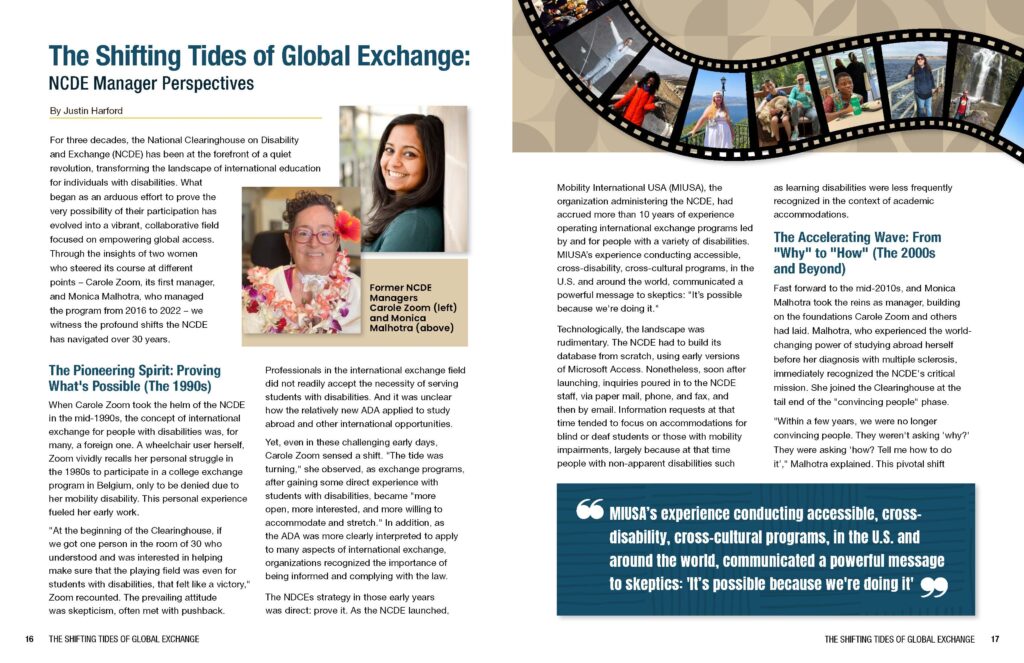
For three decades, the National Clearinghouse on Disability and Exchange (NCDE) has been at the forefront of a quiet revolution, transforming the landscape of international education for individuals with disabilities. What began as an arduous effort to prove the very possibility of their participation has evolved into a vibrant, collaborative field focused on empowering global access. Through the insights of two women who steered its course at different points – Carole Zoom, its first manager, and Monica Malhotra, who managed the program from 2016 to 2022 – we witness the profound shifts the NCDE has navigated over 30 years.
The Pioneering Spirit: Proving What’s Possible (The 1990s)
When Carole Zoom took the helm of the NCDE in the mid-1990s, the concept of international exchange for people with disabilities was, for many, a foreign one. A wheelchair user herself, Zoom vividly recalls her personal struggle in the 1980s to participate in a college exchange program in Belgium, only to be denied due to her mobility disability. This personal experience fueled her early work.
“At the beginning of the Clearinghouse, if we got one person in the room of 30 who understood and was interested in helping make sure that the playing field was even for students with disabilities, that felt like a victory,” Zoom recounted. The prevailing attitude was skepticism, often met with pushback. Professionals in the international exchange field did not readily accept the necessity of serving students with disabilities. And it was unclear how the relatively new ADA applied to study abroad and other international opportunities.
Yet, even in these challenging early days, Carole Zoom sensed a shift. “The tide was turning,” she observed, as exchange programs, after gaining some direct experience with students with disabilities, became “more open, more interested, and more willing to accommodate and stretch.” In addition, as the ADA was more clearly interpreted to apply to many aspects of international exchange, organizations recognized the importance of being informed and complying with the law.
The NDCE’s strategy in those early years was direct: prove it. As the NCDE launched, Mobility International USA (MIUSA), the organization administering the NCDE, had accrued more than 10 years of experience operating international exchange programs led by and for people with a variety of disabilities.
MIUSA’s experience conducting accessible, cross-disability, cross-cultural programs, in the U.S. and around the world, communicated a powerful message to skeptics: “It’s possible because we’re doing it.”
Technologically, the landscape was rudimentary. The NCDE had to build its database from scratch, using early versions of Microsoft Access. Nonetheless, soon after launching, inquiries poured in to the NCDE staff, via paper mail, phone, and fax, and then by email. Information requests at that time tended to focus on accommodations for blind or deaf students or those with mobility impairments, largely because at that time people with non-apparent disabilities such as learning disabilities were less frequently recognized in the context of academic accommodations.
The Accelerating Wave: From “Why” to “How” (The 2000s and Beyond)
Fast forward to the mid-2010s, and Monica Malhotra took the reins as manager, building on the foundations Carole Zoom and others had laid. Malhotra, who experienced the worldchanging power of studying abroad herself before her diagnosis with multiple sclerosis, immediately recognized the NCDE’s critical mission. She joined the Clearinghouse at the tail end of the “convincing people” phase.
“Within a few years, we were no longer convincing people. They weren’t asking ‘why?’ They were asking ‘how? Tell me how to do it’,” Malhotra explained. This pivotal shift prompted the NCDE to intensify its focus on providing more extensive online resources and tools, and delivering training to broader audiences. The demand for NCDE’s expertise skyrocketed, with invitations for workshops and presentations pouring in, expanding exponentially during the COVID-19 pandemic. The NCDE responded by expanding online trainings and convenings on virtual platforms like Zoom.
“Some of those virtual activities and engagement were the highlights for me,” Malhotra said, citing the Virtual Joining Hands Symposium, which drew over a thousand registrants, and the Access to Exchange Externship program. These virtual initiatives dramatically increased access to information and engagement for a global audience, bypassing the financial and logistical barriers of in-person conferences.
Today, what was once the NCDE’s unique mission for participation of people with disabilities in international exchange has become a shared commitment and responsibility.
International exchange providers are implementing a range of strategies and practices to firmly imbed disability access into their programs. These range from dedicated scholarships that cover disability-related accommodations, to intentional partnerships between disability resource offices and global education departments on college campuses. Sessions on disability access at international education conferences are commonplace, often organized by professionals within the field. There has also been a notable increase in requests for support and resources to make exchange accessible for students with non-apparent disabilities, such as dyslexia, ADHD, and autism.
Lasting Impact and Future Horizons
The impact of the NCDE is evident today in the “rights-bearing attitude” of younger professionals now carving out careers in international exchange. The NCDE not only provides information and encouragement, but also fosters a vital community of practice, a consortium of dedicated individuals and organizations.
Yet, challenges persist. Both Zoom and Malhotra touch upon the ongoing challenges of funding support for disability accommodations, particularly for high-cost needs like interpreters or personal attendants. Zoom champions innovative financial models, for example, an “insurable event” approach in which institutions proactively contribute to a fund to ensure coverage of future accommodation costs, as well as policy changes to incentivize accessibility.
Malhotra echoes this, hoping for continued emphasis on access for all, urging programs to take greater responsibility to ensure that the progress made to date continues.
As the NCDE looks to its future, the question of leadership and long-term sustainability looms. The foundation is strong, built on decades of pioneering best practices and continuous adaptation. The journey from initial skepticism to widespread acceptance, fueled by dedicated individuals and evolving technology, illustrates the profound and lasting impact of the National Clearinghouse on Disability and Exchange.
The NCDE is a testament to the power of persistence, partnership, and the enduring belief in international exchange, with all its transformative power, should offer a World of Options™ for all. ■
This article is part of the AWAY Journal – NCDE’s 30th Anniversary Issue